Read At Your Own Risk
For this Side Quest, I have chosen to examine how three of my favorite games–Animal Crossing: New Horizons, Stardew Valley, and Celeste–introduce narrative plot. While Animal Crossing and Stardew Valley are both essentially open-world task-based games, Celeste is a challenging platformer. Despite the differing game style, they all have unique plots and characters which are revealed along the way.
In Animal Crossing: New Horizons, you start out with a montage explaining that you have moved to a deserted island to start a new life. You receive a few basic introductions to characters like Tom Nook–evil colonizer/landlord–and his demons-in-training, (also known as “sons”) Timmy and Tommy. Tom Nook guides your experience on the island to a certain extent, explaining how to make new tools and use them to gather resources and improve your getaway experience. As you continue throughout the game, you need Tom Nook’s help less and less, especially with new introductions to characters like Isabelle, who helps with Resident Services, and Mable, who ends Nook’s monopoly on commerce. As more villagers move in and you meet new animals on abandoned islands, you learn their backstories and personalities, and eventually receive gifts and recipes as your friendship strengthens. While the game has no linear plot, you learn from villagers and administrator-raccoons how to unlock new mechanics by completing tasks and triggering events, like the arrival of renowned pop-sensation K.K. Slider (big fan of his hit “K.K. Comrade”). In this way, interaction with the characters and physical elements of the environment drives the plot and reveals new narratives.
Similarly, in Stardew Valley, you begin with a montage describing your life at a dreary desk job before finding a letter from your late grandfather with a deed to an abandoned family farm included. Soon, you depart from your cubicle and start out on an adventure to restore the ole family farm to its former glory. Again, like in Animal Crossing, the montage is the first and last time that information is directly shared with you. Once you begin your new life on the farm, you gather narrative branches and tasks from townsfolk with whom you develop a friendship. In this game, you have a journal to keep track of “side quests” which often turn out to help your progression in the main gameplay. Stardew Valley also includes no set, linear narrative, but you can advance and unlock mechanics by getting married, expanding your farm structures/house, and restoring the community center. There are also periodical events that may trigger when you reach new seasons and grow in your bonds with other townsfolk.
Celeste differs entirely from these two games. In Celeste, you receive no real “introduction” montage. You are simply a girl on a mountain who wants to reach the top. However, throughout the levels, you meet new characters, and have memories of old ones, which reveal more information about protagonist Madeleine. You soon learn that the mountain has mysterious powers and that you have some sort of evil twin sharing a body with you. The whole game functions as a metaphor, though, so your battles with Badeleine and numerous deaths equate to struggle with mental illness. To further this plot, the levels are designed to make the player feel anxious, defeated, or even depressed, revealing more about Madeleine’s struggle and the mental health of other characters she interacts with. This game has more of a linear plot, but reveals it in a complex manner through in-level mechanics as opposed to long stretches of dialogue. Celeste is a beautiful game that honestly could double as a good therapy sesh in times of need. The narrative unfolds without resistance or great pause and allows the player to be fully submerged in the story of Madeleine.
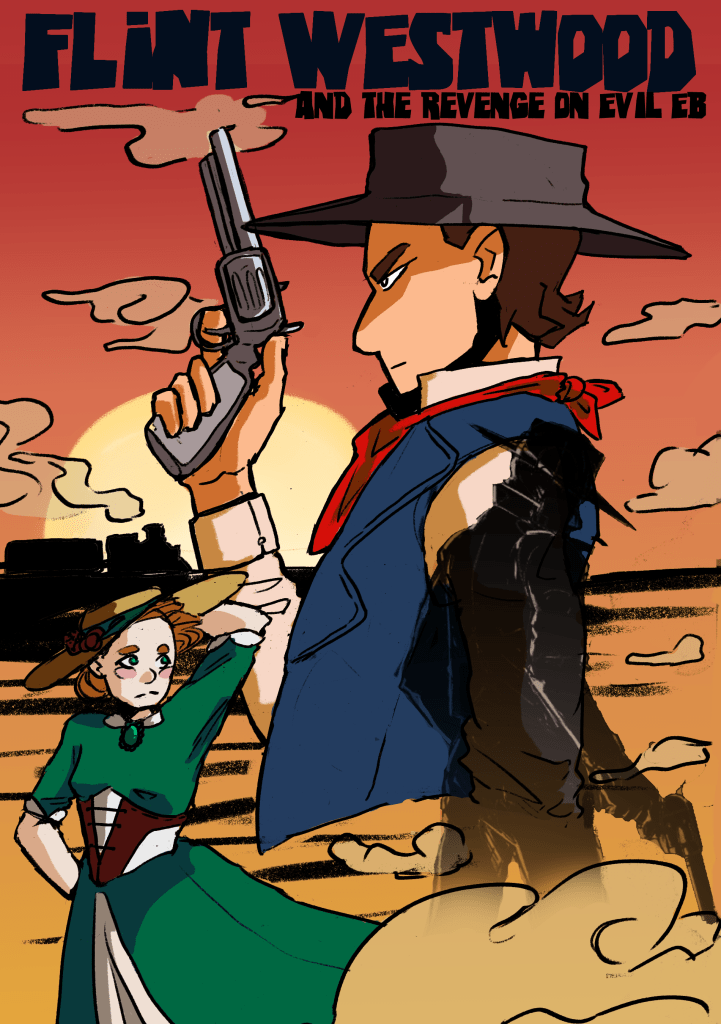
While I struggle to create beautiful art with my own two hands, I do have the privilege of calling a Real-Life-Digital-Artist my sister. I contacted her with some loose sketches for inspiration and allowed her to play the game through so she could create some great cover art for the game on commission. Because of her own online classes and the current state of the world, she could not complete the art as early as we would hoped and I struggled with learning how to put it in the actual game. However, were I to present my game to Real Life Developers, this would be presented as the cover art. Thank you Amaya. (Follow her new Insta for more great work @winch.n)
Attached is our completed D.I.E. and G.D.D. for the Final Boss! We worked as a team pretty well and completed everything far before the deadlines we set. While I don’t have much experience with coding, my group allowed me to do the bulk of the work in the GDD to set up the game for best success. My teammates executed the coding process perfectly and I was thankful for our distribution of labor. Our plot translated well into gameplay and after receiving comments on the GDD and applying a bit of editing, I have pride in this fun little Western-Mystery game. I hope you do have fun playing it!
https://playslashwrite.space/307/wp-content/uploads/2020/05/The_Revenge_of_Flint_Westwood.html
I chose to focus on the A.G.E. for my revision because I liked the concept the most. In fact, I might even try to revise this to a publish-able game and see about actual corporate interest in the game concept. As a result, Quinn focused on updating the graphics to be more clear, and I am updating the rules to make it easier to follow for players at home. Some of the rules were ambiguous or different in parts of the rulebook, so I made sure they were consistent throughout. I also took into account the issues we faced, both with gameplay in class and in the critiques I received from the Game Master. The rules should now be easier to follow and sort through. While some of the roles contain the same phrasing, which I received a comment about, I did this deliberately to ensure players knew what their goal in the gameplay was. The Sheriff, Reverend, and Witch Hunters all share the goal of discovering who the Witch in the game is. Additionally, I believe some of the gameplay issues from class could be resolved by playing the game in a smaller area, like a living room in a house/apartment. Besides this, I made updates based on all other comments and took into consideration some confusion which arose in class.
At first I didn’t know what to put on my video game playlist, since I don’t usually pay much attention to the music in games. However, as I was doing research on soundtracks from my favorite games, like Animal Crossing, Stardew Valley, and Mario games, I realized that there is a whole beautiful world of game-related music out there waiting for me to find. As I began adding songs, more recommended music appeared in my queue and took me down a path of beautiful discoveries. The anxiety music in Celeste reminds of a genuine feelings of anxiety, not just from fearing a death in a video game, but of real life. In contrast, the digital pop-esque music from Megaman soundtracks remind me of the joy of playing games, and the gratification of a victory. And of course, songs like Lana Del Rey’s “Video Games” remind me of the significance of the virtual alternate realities that live inside of video games, and how similar or different they are from real life. Overall, this playlist represents my own journey through my life as a “gamer” and the significance it plays in day-to-day life.
The test-playing of my game went surprisingly well. I was concerned it had gotten too complex, but I noticed that most players were able to catch on to the rules pretty quick, with only a few questions, mostly regarding trial questions. Most people seemed to have a lot of fun accusing their friends of witchcraft and participating in the mini games, so I consider the core mechanics of the game a success. While I wish I had a bit more creativity in the lingo of the game (role names, trail descriptions, etc.) it is rather hard to embed it into every aspect of a complex game while still maintaining the desired effect of the mechanics.
Ideally, this game would be played in a more intimate setting than a classroom, like a coffee table in a living room, which would eliminate the problem of the GM having to walk around and talk simultaneously. However, to further resolve any potential issues, since it does have such a large player requirement, I have decided to make the passing out of test prompts a feature of the night, so no one can see the GM passing out different prompts to players. Additionally, this will allow for the witch to cast curses involving the trials (like the Switcheroo curse) in the secrecy of night. Because of this change, I have also decided to change the Judge mechanic to a night-time happening, so that the Judge can tell the GM who to pass the prompts to, and so that they can see which test will be administered before choosing who to test. Another problem we considered through gameplay is the power of the Sheriff. It was too difficult to reveal a role card, and we did not think it was necessary to allow him to see which role the accused person was, so long as he knew whether or not they were the witch. To remedy, we decided the Sheriff will simply point to a suspect, and the GM will nod yes or no to signify whether his suspicions were correct. Finally, I thought that the witch hunters had far too much time and freedom to carry out as many burnings as they pleased every single day, so I decided to limit the burnings on the fifth day to only one, to prevent them from simply burning all the suspects just in the knick of time. With these simple rule changes, and a more friend-group based demographic of players, I believe this game will run smoothly and be a lot of fun!
It is the year 1693, in the town of Salem, Massachusetts. You have been informed there is a Witch amongst you. Find out who the Witch is and burn them before the sixth night to save the town from an eternal curse!
In my hidden role game, players will work together to figure out who amongst them secretly possesses Satanic power. The Witch will have allies too–a familiar or two who will protect and aid her on her quest for vengeance. Witches have been oppressed for far too long! She now wishes to give the townsfolk of Salem a taste of their own medicine by casting the Curse of Loss. However, she has been suspected, and must first pass tests in the five day witch trial to avoid being burned. Among the witch-hunting townsfolk, there is a Fool, who attempts to convince the others that he practices witchcraft; a Sheriff, who may conduct investigations throughout the night to discover who has been casting curses; and of course the Reverend Samuel Parris, who can use his priestly powers to save one civilian from a curse in the night. Additionally, there will be a rotating Judge role (kinda like jury duty), who will decide which suspected townsfolk will be tested in the trials of daybreak. Townsfolk can voice their accusations and even burn suspected witches if they gather four sticks to build a pyre. However, each witch hunter only has three sticks with which to vote, and must use them wisely. This game is for any hidden-role fanatic who wishes to relive the glorious year of 1692. Some of the test categories work best with friends, so it’s best to play with a group you know some details about. Because of the complex structure of the game, and some of the content matter, it would probably not be suitable for children, so I recommend ages 15+.
RULES:
First, the game will be divided into night sections and day sections, mediated by the Game Master. The night sections will come first, allowing players to act in their secret roles.
Night
Every role who works at night will be instructed when to awake by the Game Master. After the actions of each role has been carried out, the Judge will instruct them to fall back to sleep before the next character awakens. The first player to awake will be the Sheriff, and will be given an opportunity to accuse one player of being the witch; the Game Master will then either confirm or deny the Sheriff’s suspicions with a head nod or shake. The second player to wake will be the Reverend. The Reverend will point at a player they wish to save from a curse. The next role to awake is the Witch. When the Witch wakes up, the Game Master will turn over a curse and test card. However, if the Witch suspects a Sheriff, she can signal to the GM with a thumbs down to forgo the curse, then point to whom she thinks the Sheriff is. If she is correct the Sheriff will be dead upon the next morning. If the Witch chooses to cast the curse, she will then point at 1-2 players to curse, based on the ramifications of the curse. The final player to wake will be the Judge, who can see the new test card and then will point to the players whom they want to test. Once everyone has fallen back to sleep, the GM will pass out the appropriate prompt cards to all sleeping players. The nights will go on like this until the final night when the Witch curses the whole town.
***In the very first night, the Witch will keep her hand up after falling back to sleep so that the Familiar(s) can briefly wake up to identify the Witch and their fellow Familiars.
Day
When the procession of the night has played out, the GM will instruct all players to wake up. First, the GM will reveal what curse, if any, has been cast, and if warranted, who has fallen subject to the curse. Then the GM will reveal whom the Judge has decided to test. There are 5 different types of tests, for each player will receive a prompt and the witch a different but similar prompt. Draw Something gives players prompts to draw a specific object. Name Someone requires everyone in the room to point at an individual after 5 seconds pass. Number games require everyone in the room to put up a number of fingers based on the prompt. True or False requires players to raise their hand if the statement is true, or if it is false keep their hands down. The final test is Fill in the Blank in which players will complete a phrase or answer a question. The GM will instruct all players to turn over their prompt cards. For Name Someone and Number Games, the GM will simply count down from 3 to prompt all players to either point or hold up numbers at the same time. For all other prompts, the GM will start a timer for 15 seconds, at the end of which all players will reveal what they have written or drawn in their notebooks. Once all answers have been revealed, players are free to discuss their suspicions or argue their cases. At the end of the day, the Judge card is passed to the next player.
Voting
After the daily testing players can accuse anyone they want. Players are allowed to defend themselves. However, if players are able to get four sticks together they will burn that player. After being burned the player can no longer speak or participate in tests. Players can use all their sticks, but if they run out of sticks they can no longer vote, but may continue regular gameplay otherwise. If everyone runs out of sticks, the Witch wins. So be careful who you burn! There is no limit on the number of burnings that can be carried out in one day, except on the final day in which only one burning can take place. Players can forgo a vote if they do not feel confident in burning anyone. If players succeed in burning the Witch, the Witch loses and the community prevails. If all players fail to burn the Witch before the end of the fifth day, the Witch prevails and casts the eternal Curse of Loss on the whole town.
I am interested in creating a hidden role game for my second boss fight. In these games, players attempt to identify the odd one out, in one way or another. One of my favorite hidden role games is Secret Hitler. In this game, most players are liberals who try to work together to discover who is hiding their fascist agenda, and prevent Hitler from getting into power before passing five liberal policies. One of the most important mechanics of the game includes discussion with other players to try to identify who is lying. Additionally, there is a decent amount of strategy involved for the Hitler/fascist team, who must be careful not to seem too suspicious by passing too many fascist policies. One of the most interesting mechanics to me is the “investigation” feature, in which one player gets to look at the role card of a suspected player. This game involves a lot of deception, anger, and laughter, and can really bring people together, so it plays heavily into the fellowship core mechanic.
In my game, I would like to mimic the hidden role feature of Secret Hitler, and prompt players to discuss the clues they find and work together to discover the liar. However, I hate being one of the fascists or Hitler, because I find it too hard to lie consistently and accomplish my goals throughout the duration of a game. Consequently, I would like my game to provide something for the hidden player to do throughout the game rather than just lie. Similar to games like Fakin’ It from Jackbox, I would like to have mini games to add an extra element to game play. So that it is not too similar to existent games, I will add a fun theme that I haven’t seen in many other games. I’m thinking something witchy…
It’s not a weekend without a game night with my friends! Here are some of the analog games I always root for when deciding what to play, in no particular order.
To begin my analysis on Stardew Valley, I looked to interviews with the sole creator of the game, Eric Barone, in which he reflects on his own struggle to build a fulfilling, survivable life in a capitalistic society. When he failed to find any job in which he could utilize his talents to support himself, he turned to video game programming as both a practical reallocation of his computer science skills and to purge these criticisms of industry. Many of his lamentations about the rise-and-grind structure of the current market translated into the fundamental concept of the game. Since the game is a type of criticism in and of itself, I have decided to critique how Stardew Valley emphasizes the downfalls of a capitalist market by somewhat forcing you to participate in it on a small scale, while also highlighting the benefits of participating in a communal life, by rewarding the player for donations to the museum and community center. My desired audience would optimally be comprised of people who are not critical of capitalism. To create my criticism video, I will only need my laptop, as it has a high quality mic and video-editing capabilities. I still have much work to do on the project and intend to dedicate my weekend to filming and polishing the video. I anticipate facing obstacles in my video editing, as I am not adept in this area, but I’m sure I will be able to craft a quality project using the tools available on both the class website and the Alabama website. For now, my main questions for my Game Master are simply whether the scope of this project is too broad or if I am really accomplishing the goals of the prompt through this idea.
OUTLINE

 Phoenix's Blog